

Alicia Keys, photographed before the release of her debut studio album on East 21st Street in New York by James Patrick Cooper in early 2001.
Cooper used the Mamiya M645 camera with Fujifilm NPS 160 film to photograph the young star.

Alicia Keys, photographed before the release of her debut studio album on East 21st Street with Gramercy Park in the background in New York by James Patrick Cooper in early 2001.
Cooper used the Mamiya M645 camera with Fujifilm NPS 160 film to photograph the young star. This was the first time he met Alicia, describing the shoot to social media: “The first time I met Alicia Keys and had her hang out the studio window over E21st. This was before her first album on J Records ‘Songs in A minor.’”

Alicia Keys, photographed wearing Iceberg for the cover of the 78th issue of British lifestyle magazine Dazed & Confused (now Dazed) by Terry Richardson in June 2001.
In Alicia’s 2020 memoir More Myself, she recalls how she felt “manipulated” and “objectified” during a photoshoot before the release of her debut album around 19-years-old. Although she did not name the photographer nor publication, many fans and news outlets drew unmistaken comparisons between her descriptions.
Known to models as "Uncle Terry," Richardson has been infamous since the 1990s for "an almost soft-p*rn aesthetic" featuring nudity, innuendo and simulated sex acts, according to The Guardian. Since the early 2000s, he’s been accused multiple times of using his influence in the fashion industry to sexually exploit models during shoots. In 2017, major fashion magazines like Vogue, GQ and Vanity Fair announced they would stop commissioning Richardson.
While on set, the photographer insisted that he needed to shoot photos of her alone, which her team obliged. “When I emerge from the dressing room, there’s just the two of us on set. ‘Open up your shirt a little,’ he directs while firing off a flurry of camera snaps,” Alicia writes in her book. “My spirit is screaming that something is wrong, that this feels sleazy. But my protests, lodged in the back of my throat, can’t make their way out.”
The photographer then asked her to pull the top of her jeans down a bit in the front. “If I say no, what doors will be closed to me? I swallow my misgivings, tuck my thumb between the denim and my skin, and obey,” she recollected. She says she “cried harder than ever” once she went home after the shoot. Alicia was appalled once she saw the cover when it finally dropped. “On the day of the cover’s debut, I pass a newsstand where the magazine is on display. I almost throw up.”
Alicia added that the discomfort didn’t just stem from showing skin on a magazine cover, it was the feeling of being taken advantage of: “This isn’t about me showing some skin, which I’ll do on my own terms, for my own purposes, in the coming years. It’s about feeling manipulated. It’s about being objectified,” she writes. “I am beyond embarrassed, ashamed that I’ve sold part of myself…Had Jeff Robinson been in there, he would’ve voiced what I couldn’t at the time: Hell no. Close that shirt. Take your hand off your tit. And you’re not going to yank down your jeans.”
The experience had a profound impact on the now mother: “I swear that I’ll never again let someone rob me of my power,” she wrote. “It’s a promise I still work to keep.”

Alicia Keys, photographed exclusively for her feature in the October issue of Vibe magazine by Danielle Levitt in 2001.
She wears a black sheer long-sleeve top with a zip-up neck by Dolce & Gabbana, blue denim zebra-striped pants with snakeskin detail by Baby Phat, and a black leather belt by Plein Sud.
Brooklyn-based former executive editor of Vibe Lakán Angelo Ragaza writes about the new J Records artist in a walk-up studio in Alicia’s native West Side Manhattan neighborhood of Hell’s Kitchen as she rehearses for her support act on Maxwell’s upcoming national tour in July. Alicia’s Songs in A Minor debuted on the Billboard 200 at No. 1, selling over 236,000 copies at the time.
“It’s been one trial, one test of confidence and faith after the next,” Alicia confides to Vibe. “Success doesn’t just mean that I’m the singer, and you give me my 14 points, and that’s all. That’s not how it’s going down. I plan to expand, in every way possible.”

“The Maestro”
Alicia Keys, photographed exclusively for her feature in the October issue of Vibe magazine by Danielle Levitt in 2001.
Brooklyn-based former executive editor of Vibe Lakán Angelo Ragaza writes about the new J Records artist in a walk-up studio in Alicia’s native West Side Manhattan neighborhood of Hell’s Kitchen as she rehearses for her support act on Maxwell’s upcoming national tour in July. Alicia’s Songs in A Minor debuted on the Billboard 200 at No. 1, selling over 236,000 copies at the time.
Father to So So Def Recordings’ Jermaine Dupri, Michael Mauldin signed Alicia to the Columbia label when he was senior Vice President of black music. But when he left the label, Alicia languished in development hell. “I think he had the vision for where she was going to be,” Dupri says to Vibe. “Nobody else had that same guidance as far as watching over her project and making sure it was going to go down the way he planned—a real project that you have to take your time with. It probably was a sour experience for her.”
“It’s been one trial, one test of confidence and faith after the next,” Alicia confides to Vibe. “Success doesn’t just mean that I’m the singer, and you give me my 14 points, and that’s all. That’s not how it’s going down. I plan to expand, in every way possible.”

Alicia Keys, photographed in New York City by British photographer Platon in July 2001.
Platon was commissioned to shoot several artists from new label J Records including Angie Stone, Luther Vandross, and Alicia Keys.
He expressed in a magazine in 2001 that he was “expecting a nightmare.” “Normally, artists are very suspicious of each other. There’s a lot of competition and egos. I was expecting big entourages of people, a lot of attitude.”
But by the time Alicia arrived, all his fears had faded away: “She was as charming as she is beautiful,” he says of the young star. “She came in, drank a glass of water, and sat down. It was wonderful.” Further commenting that Alicia arrived to the shoot without stylists, makeup artists or wardrobe people, which surprised the photographer.
Born in London and raised in the Greek Isles, Platon worked for British Vogue for several years until he was invited to NYC to work for the late John Kennedy Jr. and his political magazine, 'George.’ Shooting portraits for a range of international publications including Rolling Stone, the New York Times Magazine, Vanity Fair, Esquire, GQ and the Sunday Times Magazine, Platon developed a special relationship with Time magazine, producing over 20 covers for them.

Alicia Keys, as featured on The WB’s presentation of Teen People magazine’s “What's Next” television special hosted by singer-songwriter/actress Mandy Moore in NYC and broadcast in November 2001.
This special was to celebrate and showcase some of the hottest new talent in the industry, with picks from Teen People’s next generation of superstar actors and musicians. Alicia, Ja Rule, Craig David and Nelly Furtado covered the December 2001/January 2002 issue of Teen People’s magazine release.
From Manhattan’s Hammerstein Ballroom on 311 West 34th Street, The WB broadcast live performances by N.E.R.D., Michelle Branch, Blu Cantrell, Craig David, Ja Rule and Alicia.
Here in NY, artists sat around a round table and got to chat and answer questions from host Mandy Moore backed by a live studio audience.
And with her piano, Alicia gave a performance at the Ballroom of “A Woman’s Worth.” A song that reached number seven on the Billboard Hot 100 and later became one of her most recognizable hits.
During the broadcast, Mandy asks the singer if the sudden fame has been overwhelming at all, in which Alicia responds optimistically: “I try not to look at it like that, like ‘overwhelming’. I try to look at it like something that has been something that I’ve been striving for, for a very long time. Something I’ve been really wanting to do, and so, to just finally see it manifesting is very—it’s a blessing.”
When asked by Shay Haley of N.E.R.D. of what her next album will be like, Alicia comments: “I’m going somewhere real special. I really want to just dig in kind of deep and bring some different topics to the table. So, it’s gonna be interesting.”
Following up, Pharrell of N.E.R.D. comments on Alicia’s cover of Donny Hathaway's 1973 song "Someday We'll All Be Free" that she performed at the America: A Tribute to Heroes televised benefit concert following the September 11 attacks just earlier in the year: “I was in a house full of girls, and every last one of them was in tears.”

Alicia Keys, Ja Rule, Craig David and Nelly Furtado, photographed for the cover of the December 2001/January 2002 issue of Teen People magazine's "What's Next" special by Dominique Palombo.
Alicia’s makeup is done by Ayako for Nars Cosmetics. She wears a coat by Andrew Marc, pants by Laundry, and earrings by Nine West Jewelry.
The four artists featured on The WB’s presentation of Teen People magazine’s “What’s Next” television special hosted by singer-songwriter/actress Mandy Moore in NYC and broadcast in November 2001.
This special was to celebrate and showcase some of the hottest new talent in the industry, with picks from Teen People’s next generation of superstar actors and musicians.
From Manhattan’s Hammerstein Ballroom on 311 West 34th Street, The WB broadcast live performances by N.E.R.D., Michelle Branch, Blu Cantrell, Craig David, Ja Rule and Alicia. Here in NY, artists sat around a round table and got to chat and answer questions from host Mandy Moore backed by a live studio audience.
“What’s next is definitely another single, and that’s ‘A Woman’s Worth,’” says Alicia to WB. “And then continuing to do, you know, writing and producing different songs with different artists along with my team KrucialKeys and myself. I just hope that it’s something—that the music is something that [fans] can relate to. I think in part it may be due to that it’s a little different sound or a different style. It feels rewarding to be What’s Next and it feels like a wonderful thing.”

Alicia Keys, as featured on The WB’s presentation of Teen People magazine’s “What's Next” television special hosted by singer-songwriter/actress Mandy Moore in NYC and broadcast in November 2001.
This special was to celebrate and showcase some of the hottest new talent in the industry, with picks from Teen People’s next generation of superstar actors and musicians. Alicia, Ja Rule, Craig David and Nelly Furtado covered the December 2001/January 2002 issue of Teen People’s magazine release.
From Manhattan’s Hammerstein Ballroom on 311 West 34th Street, The WB broadcast live performances by N.E.R.D., Michelle Branch, Blu Cantrell, Craig David, Ja Rule and Alicia. Here in NY, artists sat around a round table and got to chat and answer questions from host Mandy Moore backed by a live studio audience.
“What’s next is definitely another single, and that’s ‘A Woman’s Worth,’” says Alicia to WB. “And then continuing to do, you know, writing and producing different songs with different artists along with my team KrucialKeys and myself. I just hope that it’s something—that the music is something that [fans] can relate to. I think in part it may be due to that it’s a little different sound or a different style. It feels rewarding to be What’s Next and it feels like a wonderful thing.”


Sisqó, Pink and JC of N’Sync were additionally among the 25 Hottest Stars Under 25 as they covered the May issue of Teen People’s magazine release in 2001.
Teen People’s Senior Entertainment Editor Gloria Wong speaks on selecting Alicia for the list: “There was no way we couldn’t put Alicia Keys on the list. She’s won all these awards this year. Her music is really solid. And her lyrics are really good, and she’s just a really talented person. It’s that singer-songwriter who is really feeling her emotions and putting it into her music in a way that people can feel too. It’s really exciting.”
When asked about her hot artist status, Alicia remains grounded: “Hot is your own style and you not trying to be like anybody else, you being yourself,” the singer says. “Do I consider myself hot? Well, I mean sure why not? Cause if you don’t consider yourself hot [then] nobody else will!”
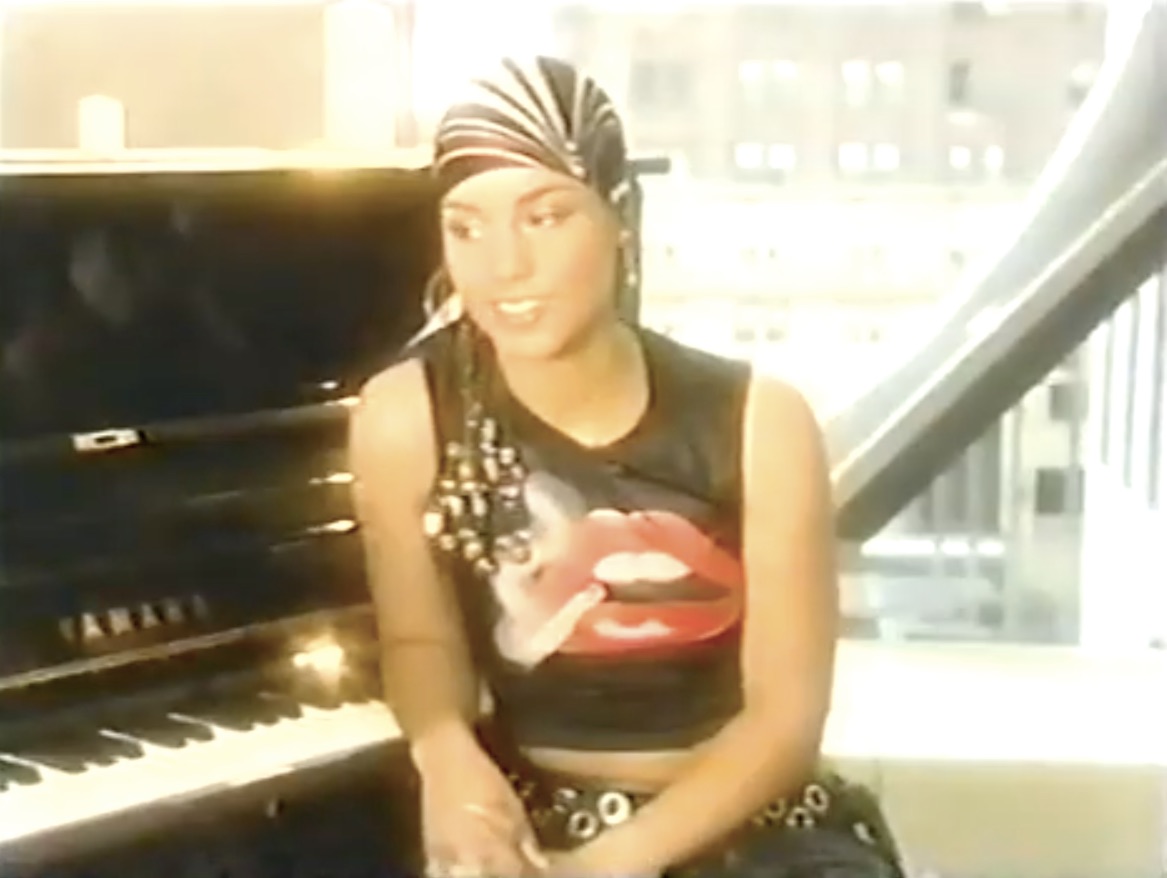
Alicia Keys, as featured on MTV’s “Fake ID Club” television program broadcast in late 2001.
The segment, hosted by The Soprano’s Jamie-Lynn Sigler, highlighted known and unknown young performers and individuals under the age of twenty-one, who weren’t even “old enough to buy a bottle of Cristal.”
Alicia’s friend Tiffany is interviewed about her No. 1 Billboard 200 friend: “She’s just a regular person. We talk about clothing. We talk about anything special that’s going on in your life, maybe a boy or something,”
The program then jumps to Alicia, and more of her personal life: “Right around the time that I wrote ‘Butterflyz,’ I was feeling some butterflies,” says the singer. “It was an instant attraction to my first love. And every time I spoke to him, or saw him, I got these crazy butterflies in my stomach. It was like, ridiculous. We talked on the phone all the time. I would sneak on the phone at night, hold the phone underneath the pillow. While my mother was in the other room. ‘Cause if she found out I was on the phone, it was kind of late, she would’ve been mad.”
Tiffany then follows up: “Yeah, we all knew him. Just like, knowing Alicia, I kind of had an idea that ‘Fallin’’ was for Mr. ‘Butterflyz.’”


Alicia Keys, photographed for the first time in Amsterdam by Paul Bergen in November 2001.
Debuting at number one on Billboard’s 200, Songs in A Minor garnered Alicia to tour Europe for the first time. Visiting places like London and Germany. She would perform at Club Panama in Amsterdam’s Eastern Docklands, with coverage by The Music Factory (TMF).

Alicia Keys, photographed in Köln (Cologne), Germany by Frank Lothar Lange in November 2001. Lange captured this image with a Mamiya RZ67 camera.
Debuting at number one on Billboard’s 200, Songs in A Minor garnered Alicia to tour Europe for the first time. Visiting places like London, Amsterdam and Germany.


Alicia Keys, photographed for the first time in Amsterdam by Martijn van de Griendt in November 2001.
Debuting at number one on Billboard’s 200, Songs in A Minor garnered Alicia to tour Europe for the first time. Visiting places like London and Germany. She would perform at Club Panama in Amsterdam’s Eastern Docklands, with coverage by The Music Factory (TMF).

Alicia Keys, photographed performing for the first time at Club Panama in Amsterdam's Oostelijk Havengebied (Eastern Docklands) by Peter de Jong in November 2001.
Debuting at number one on Billboard’s 200, Songs in A Minor garnered Alicia to tour Europe for the first time. Visiting places like London and Germany. The Music Factory (TMF) filmed and broadcast Alicia’s performance at Panama with their additional interview with the star spliced in-between sets.
Alicia performed cuts like Marvin Gaye’s “Trouble Man,” Roberta Flack’s “Killing Me Softly with His Song,” “Troubles,” Prince’s “How Come You Don’t Call Me,” “A Woman’s Worth,” and “Fallin’.”
Alicia wears Jerome Bettis’ “36” Pittsburgh Steelers Puma jersey (cropped).

"Alicia Keys: A Soul Star Is Born"
Alicia Keys, photographed performing at her first J Records showcase at Greenwich Village’s Bottom Line in New York on March 15, 2001.
Rolling Stone magazine’s 867th issue featured a brief article of the showcase.
Alicia was introduced by Clive Davis, who compared her rise to fame as that of a young Bruce Springsteen. Rolling Stone described her style as a blend of Stevie Wonder, Michael Jackson and Janis Joplin.
“All the work I’ve put into this, it’s nice to see it manifesting,” Alicia said. “There was so much genuine love out there.”

“New Singer Alicia Keys Sitting Pretty With Smash Debut Album ‘Songs In A Minor’”
Alicia Keys, photographed by Tony Duran on the cover of JET magazine for their August 13 issue in 2001.
For her cover story, Margena A. Christian speaks to Alicia about her new debut studio album and a bit about the 20-year-old’s personal life.
Amongst the success of the album, Alicia comments on the rising popularity of “Fallin’”, and the fact that the single was even being featured in TV soap commercials: “Isn’t it crazy? I think it’s crazy,” she says to JET about the song’s impact. “In fact it kind of sounds like a soap opera song. I was thinking, ‘Hey, wait a minute!’”
JET comments about her marriage between classical and soul music, she adds: “I am truly blessed that people are really into it. But I really didn’t know that I was doing it,” she admits. “It was kind of something that comes natural to me, studying classical for so long and having a love of soul and R&B music. It’s kind of something that fused together by itself. I think people are always ready for something different.”
“People who don’t know me ask me if I’m an MC,” she chuckles. “They always ask me, ‘Do you rhyme?’ I say, ‘Well, I could rhyme if I wanted to.’ They get a kick out of it. I think classical music has a notorious reputation for being a little stuffy, and I think this just kind of brings it down to earth.”
Alicia also mentions the possibility of returning to college after leaving as her career was kicking off: “I have always been working toward this. When it was finally looking like it was jumping off, I was like I see an opportunity to really do this…I think school is important and I want to definitely go back even if I have to so an Internet college course.”
Here she also reveals the inspiration for the albums second single, “A Woman’s Worth,” which came during a Thanksgiving family dinner: “I was watching TV when a L’Oreal commercial came on. At the end it said, ‘Because I’m worth it.’ I said, ‘Oh, my goodness! Damn, I’m worth it! That’s hot!’ Time passed and I played it on the piano and recorded it. I started thinking how important it is to feel like you’re worth it. If you know you’re worth it, you won’t let people treat you any which way. In a relationship you are worth the special things—not just monetarily, but sweet little things. As a woman, you’re worth it.”

The Chicago Tribune reports that Alicia performed for a crowd of 700 packed into the infamous E2 nightclub on South Michigan Avenue in Chicago, Illinois on Thursday, August 9, 2001.
The set reportedly only lasted 20 minutes, which left some fans disappointed. Though, the 20-year-old greeted the crowd with a smile. Shouting from behind her keyboard: “You know what I got for Chicago?,” then pounding out the familiar melody of Mary J. Blige’s “Real Love.”
It seemed Alicia wasn’t accompanied by a band, only the company of her keyboard during most of the “Afterwork Set,” sponsored by local station WGCI (107.5 FM). But Alicia made up for the lack of instruments with her powerful voice. After warming up with Beethoven’s “Für Elise,” she sang her cover of Prince’s “How Come U Don’t Call Me.” Without trying to seem too disappointed, she told the crowd that being able to be in Chicago meant that she had to pass an opportunity to perform with Prince in his hometown of Minneapolis. Although, she “looked comfortable with the mass of mostly female crowd, standing up and pacing the stage in tight-fitting black pants, a black lace one-sleeved topand and gold scarf covering her braids and gold hoop earrings.”
Soon performing the second single "Girlfriend," from her debut album, which was currently sitting at No. 3 on the charts. But it was her No. 1 single that everyone was excited to hear, “Fallin’.” Fans sang along so loud that Alicia “had no need for backup singers.”
Then at 9:05 p.m., 20 minutes after her big entrance, she exited the stage. “At least one person who paid $25 to see the show, which also featured J Records labelmate, Jimmy Cozier and lasted 50 minutes, asked for her money back. The audience had trouble seeing Cozier because the spotlight didn’t come on until his final song.” Jimmy appeared on Alicia’s “Mr. Man” track from Songs in A Minor.
On Friday (August 10), Alicia and Jimmy performed for free in front of the NBC Tower in Chicago. Fans in the plaza clamored for pictures and autographs from the stars. Alicia would later perform in Chicago in September and December for 2001.

“The Next Queen of Soul”
Unpublished shot of Alicia Keys, photographed in lower Manhattan for her cover story of the 881st issue of Rolling Stone magazine by Mark Seliger on September 13, 2001.
Published November 8, the photographs for the magazine’s cover were captured in lower Manhattan, just two days after the World Trade Center attacks, a mile and a half from Ground Zero. The shoot was originally scheduled for September 11th.
Immediately after the shoot, Alicia and her crew were escorted to a police checkpoint at Fourteenth Street, then uptown to Washington, D.C., where a tour bus was waiting to take the young star and her band to Atlanta for a show the following night at Chastain Park Amphitheatre on the 14th. Alicia was scheduled to open for singer Maxwell, despite her debut album already selling more than 3 million copies.
